Industrial grain storage facilities face a persistent challenge: Detecting conditions that can lead to spoilage, condensation, smoldering, or even combustion before they become critical. Early identification of abnormal environmental changes inside a silo can prevent product loss, improve safety, and reduce operational costs.
As part of the LoLiPoP-IoT project, Use Case 7 explores how energy-efficient sensing, secure communications, and intelligent data processing can be combined to monitor silo conditions in real time. The demonstration showcases a complete end-to-end IoT architecture, from low-power sensors to cloud-based visualization, while highlighting opportunities for future edge-AI applications.
Simulating a Grain Silo in the Laboratory
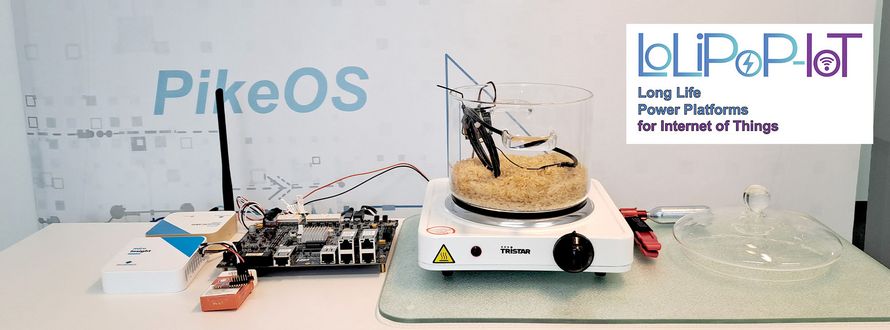
To reproduce the environmental behavior of a grain silo in a controlled setting, the experiment uses an in-vitro setup based on a glass vessel filled with rice.
The rice serves as a surrogate for stored grain, reproducing key thermal and moisture characteristics. A heating plate beneath the vessel provides thermal stimulation, while a compact multi-sensor module measures:
- Temperature
- Relative humidity
- Atmospheric pressure
- CO₂ concentration
To emulate the early stages of a hazardous event, the rice is intentionally kept slightly moist. Heat and CO₂ are then introduced into the system, creating conditions similar to those that can precede spoilage, biological activity, smoldering, or combustion inside a real silo.
The result is a controlled environment that allows researchers to observe how sensor values evolve as abnormal conditions develop.
Secure Low-Power Communication
A key objective of the LoLiPoP-IoT project is demonstrating long-life IoT platforms that operate with minimal energy consumption.
The sensor node communicates using Mioty, a low-power, long-range wireless communication technology developed by Fraunhofer. Mioty is particularly well suited for industrial monitoring applications because it enables reliable communication while minimizing energy usage.
The sensor data is received by a gateway built on the NXP S32G3 platform. To strengthen cybersecurity, the gateway integrates an Infineon OPTIGA TPM that provides hardware-rooted cryptographic identities and secure key storage.
This combination ensures that telemetry data is not only transmitted efficiently but also protected against unauthorized access and tampering.
From Sensor Data to operational Insights
The telemetry chain mirrors a realistic industrial deployment.
Sensor measurements are transmitted through the Mioty network to the gateway and forwarded using MQTT. The backend infrastructure processes the data through several components:
- Mosquitto handles MQTT communication.
- Telegraf subscribes to telemetry topics and transforms incoming data into time-series records.
- InfluxDB stores the measurements.
- Grafana provides visualization and monitoring dashboards.
This architecture enables operators to observe environmental conditions in real time while maintaining a scalable and secure data-processing pipeline.
Visualizing Silo Conditions in Real Time
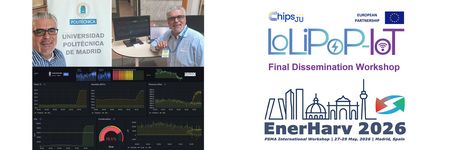
The Grafana dashboard is designed to provide immediate visibility into both operational status and environmental risk indicators.
The dashboard combines:
- Communication and connectivity monitoring
- Sensor power and energy metrics
- Temperature trends
- Relative humidity measurements
- Pressure readings
- CO₂ concentration monitoring
- Condensation risk estimation
Ambient sensors located outside the simulated silo provide baseline measurements for comparison. This allows operators to distinguish between normal environmental fluctuations and changes occurring inside the silo itself.
As conditions evolve, the dashboard clearly highlights the divergence between internal and external measurements.
Detecting the Onset of an Incident
During the demonstration, CO₂ is manually injected into the vessel while heat is gradually applied.
Almost immediately, the internal CO₂ concentration diverges from ambient conditions. The system captures this change in real time and increases its sampling frequency automatically.
As temperatures rise, corresponding changes in humidity and pressure become visible. The dashboard displays these trends as steep slopes, making the progression of the simulated incident easy to follow.
One particularly important metric is condensation risk. By combining environmental measurements, the system estimates whether conditions are approaching levels that could promote spoilage or other hazardous processes.
At the same time, the energy-monitoring subsystem reflects the increased communication and processing activity required during an incident, illustrating the relationship between operational awareness and power consumption in energy-constrained IoT systems.
Looking beyond Thresholds: The Role of Edge AI
Current risk estimation approaches often rely on a limited set of indicators, such as temperature, humidity, pressure, and CO₂ concentration.
However, real-world combustion and spoilage processes frequently generate additional signals long before dangerous conditions become obvious. Examples include:
- Oxygen depletion
- Internal temperature gradients
- Pressure fluctuations caused by biological activity
- Fermentation-related signatures
- Oxidation processes
Combining these signals could enable earlier and more reliable detection than traditional threshold-based approaches.
This presents an exciting opportunity for edge AI. Lightweight machine-learning models deployed directly on gateways or sensor nodes could continuously analyze environmental patterns and identify emerging risks before conventional alarms are triggered.
Such predictive capabilities would improve safety while preserving the low-power characteristics required for long-term autonomous operation.
Conclusion
Use Case 7 demonstrates how secure, low-power IoT technologies can provide valuable insights into industrial storage environments. By combining Mioty communication, hardware-based security, real-time analytics, and energy-efficient system design, the LoLiPoP-IoT project illustrates a practical path toward smarter and more sustainable industrial monitoring.
Beyond real-time visualization, the experiment also points toward the next frontier: predictive monitoring powered by edge AI. As energy-efficient computing continues to advance, future systems may not only detect hazardous conditions but anticipate them—providing operators with the time needed to prevent incidents before they occur.
The combination of secure edge platforms, energy harvesting technologies, and intelligent analytics has the potential to transform industrial monitoring from reactive observation into proactive risk management.
 Twitter
 LinkedIn
 Facebook
 Reddit
 RSS
RSS Copy link