From Code to Hardware: Build & Deployment Workflow
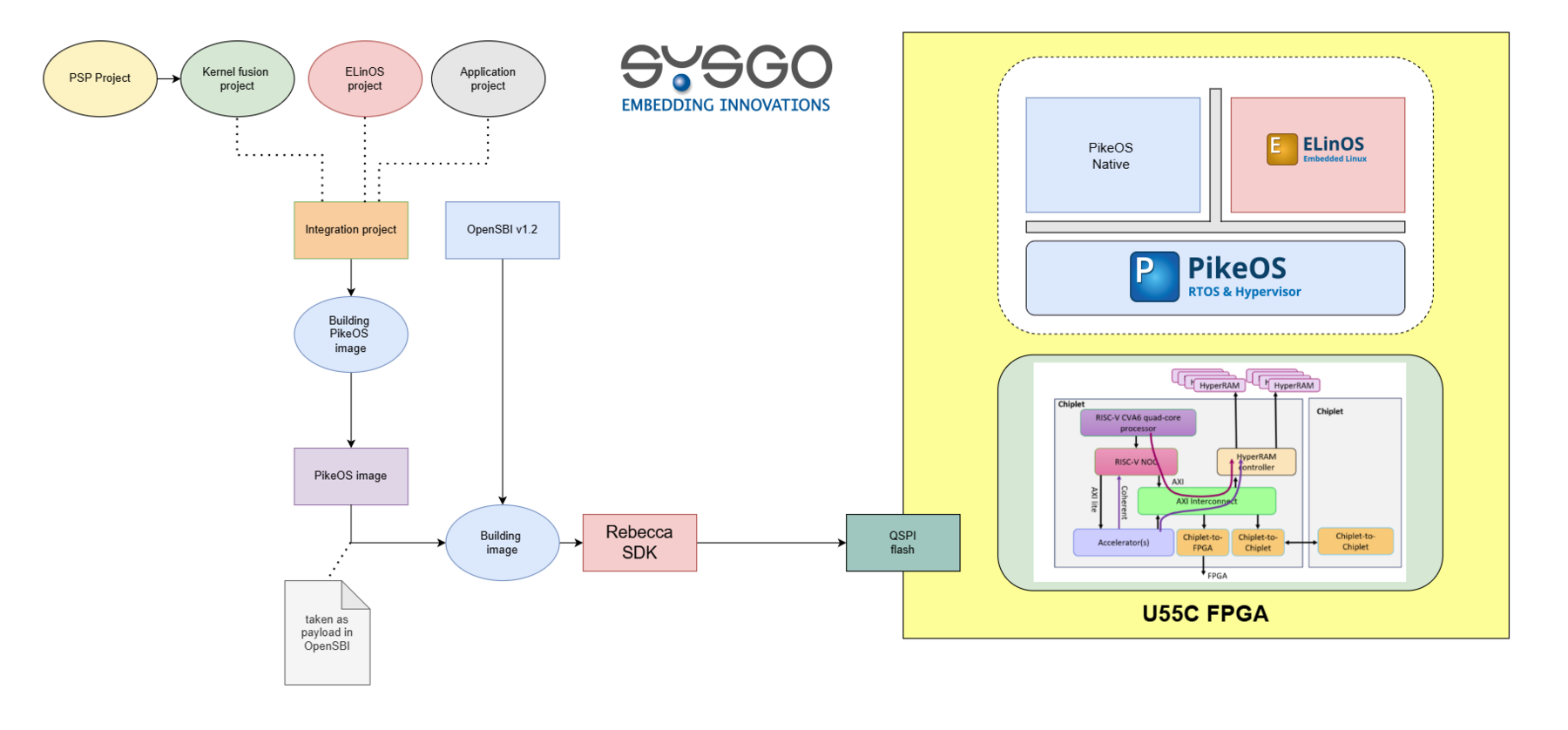
To bring the platform to life on the hardware, we established a complete end-to-end build and deployment pipeline using SYSGO’s CODEO development environment and the REBECCA SDK:
- PikeOS PSP Build: We configured and built the dedicated Platform Support Package (PSP) tailored specifically to the quad-core CVA6 hardware layout and memory mapping.
- Partition Projects: We created the individual payload projects—an ELinOS embedded Linux system for rich software services and a lightweight PikeOS native application project for time-critical logic.
- Kernel Fusion in CODEO: Using CODEO, we combined the hypervisor binary, guest partition images, memory policies, and system layout configurations into a unified Kernel Fusion project.
- Target Deployment: CODEO compiled the setup into a single bootable binary image. Using the REBECCA SDK, we flashed this final image directly into the board’s QSPI flash memory on the AMD/Xilinx Alveo U55C FPGA, enabling the system to boot autonomously on target startup.
To demonstrate the platform's virtualization and isolation capabilities, we are currently running a dual-partition setup directly on the chip:
- Partition 1: Runs a PikeOS native application, ensuring strict, deterministic real-time execution for critical functions.
- Partition 2: Runs ELinOS, handling standard embedded Linux workloads and broader system tasks.
This hypervisor-driven separation is the key to safe Edge AI. It means a computationally heavy, AI-based image processing application can run on the same physical chip alongside critical control software, without either application sharing an execution environment or stepping on the other's toes.
From the Lab to the real World
Why does this strict separation matter? Because real-world applications demand it. Take autonomous infrastructure inspection as an example. Drones checking bridges or power lines can use local AI to identify cracks or wear instantly. They don't need to beam gigabytes of high-resolution sensor data back to a remote cloud server to make a safe navigational or maintenance decision. The same principles apply to AI-based inspection of photovoltaic panels, high-speed visual checks in semiconductor manufacturing, and intelligent home appliances. In all of these scenarios, data is processed right where it is created. This enables faster decisions, reduces network strain, and removes the dependency on a permanent cloud connection.
The Road ahead
The REBECCA project proves that the future of Edge AI isn’t just about building faster accelerators. It is about creating a cohesive, trustworthy ecosystem where processors, memory, operating systems, and AI frameworks work seamlessly together. By bringing our virtualization, safety, and security expertise to the open RISC-V architecture, we are helping push the industry forward. We aren't just figuring out how to run algorithms at the edge; we are building the foundation for powerful, predictable, and genuinely secure intelligent systems.
More information at www.rebecca-chip.eu
 Twitter
 LinkedIn
 Facebook
 Reddit
 RSS
RSS Copy link